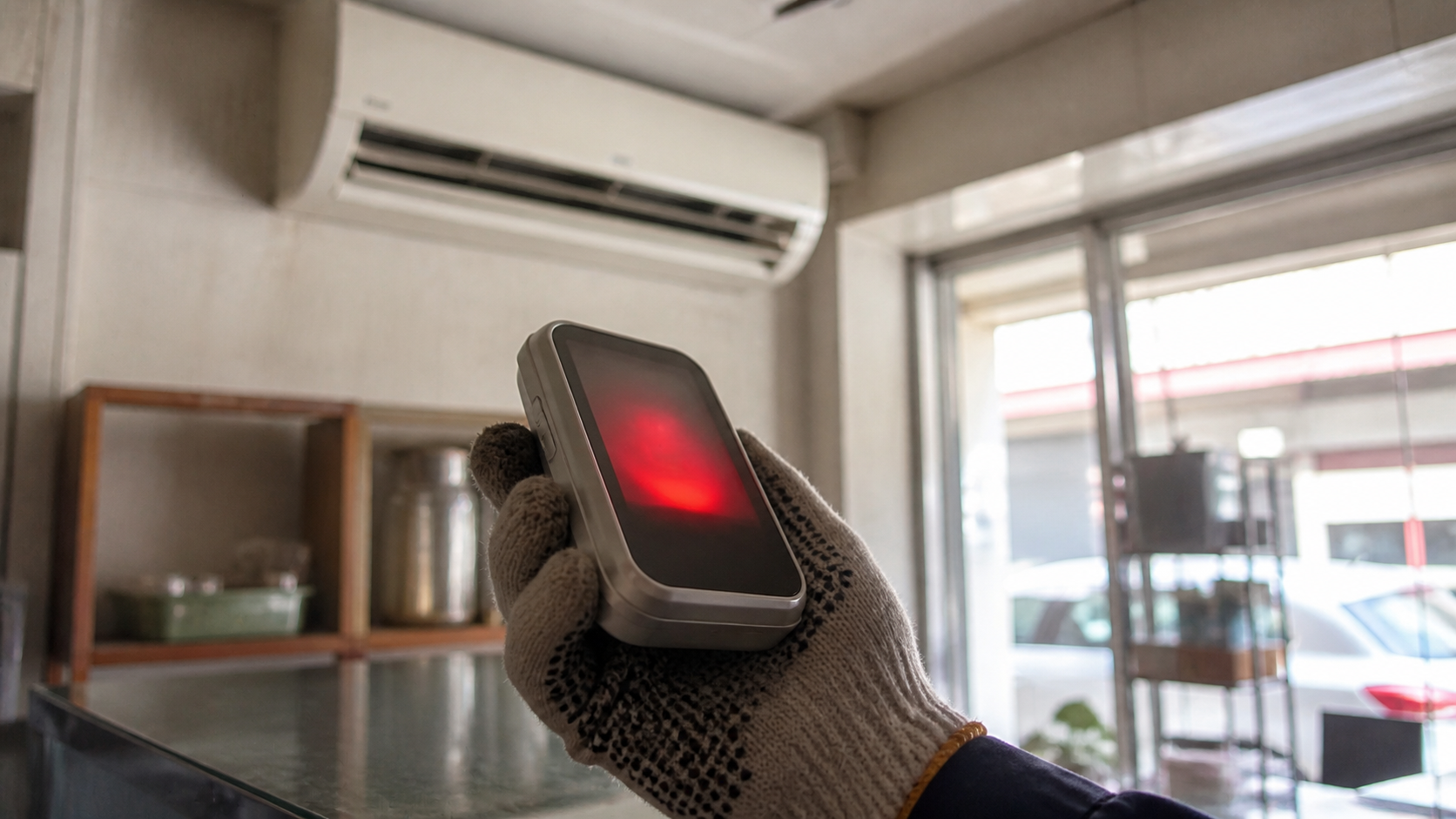
Black Mould Testing in Bangkok: The Case Where the Mould Wasn't the Problem
The owner of a Bangkok retail shopfront called us about black mould. There was a smell, a suspicion, and a business that couldn’t afford to guess. He wanted the air tested properly before anyone started tearing into walls.
Reasonable request. We attended with the air quality meter, the moisture meter, and the thermal camera, expecting a mould job.
We didn’t find one. We found something worse.
What the instruments actually found
There was no visible active mould on the premises. That finding matters on its own. It’s the difference between paying for remediation and not paying for it. But it left the question: why did the air feel wrong?
The meter answered it. We ran it through a normal working day: main air conditioner on, doors closed, two people in the space. Within forty minutes, carbon dioxide climbed to 2,197 ppm in the main area, deep in the meter’s red zone. For reference, outdoor air sits around 420 ppm, and drowsiness and headaches are commonly reported from around 1,000. We flagged it as the report’s critical finding. The smell was the least of it. The air simply wasn’t being refreshed, in a space where people spend all day.
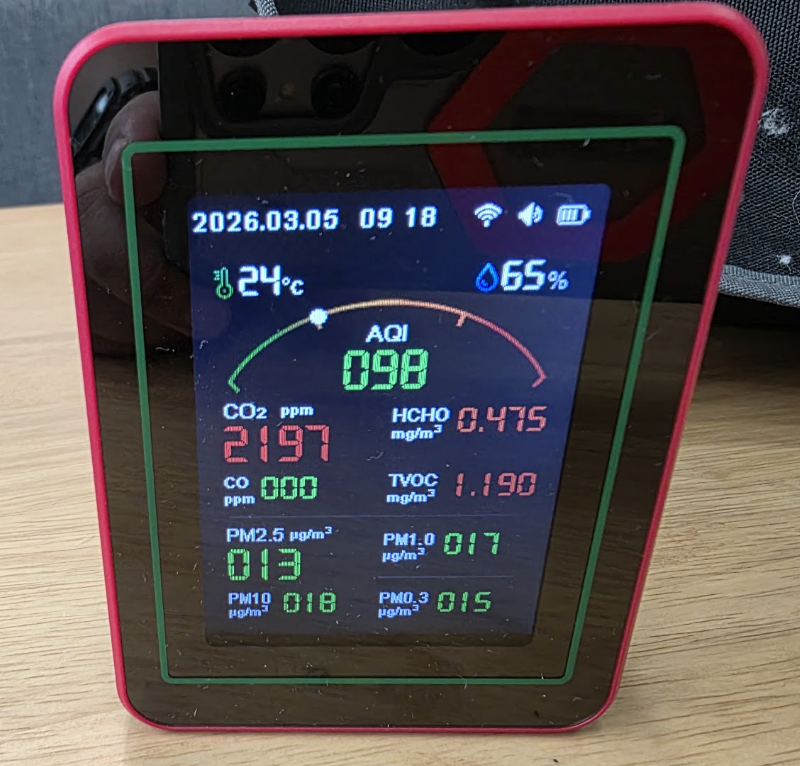 The readout, forty minutes in. The meter’s clock was never set, so ignore the date.
Two more findings framed it:
- The main air conditioner was overdue for maintenance. The previous tenant had skipped the servicing schedule, and the air quality dropped measurably whenever that unit ran. Same room, same day, the partitioned room’s well-maintained unit ran clean. The contrast was visible in the readings.
- Construction next door was pushing TVOC levels up inside the property. No amount of cleaning inside the unit would ever fix that.
Neither issue was visible to anyone walking through the space. Both were sitting in plain sight of an instrument.
Why “test before you treat” is the whole game
Calling a cleaning company is the usual first move when someone suspects mould in Bangkok. Here’s what would have happened: they’d have cleaned surfaces that had no active mould on them, charged for it, and left. The CO₂ problem stays. So does the unserviced air conditioner and the construction TVOC. The smell comes back, and the next quote is bigger.
Growth and bad air need a source: a leak, a failing seal, a cold surface, an air system holding water or simply not doing its job. Finding the source is measurement work, and a cleaning crew isn’t equipped for it. That’s the order of operations: test, then treat. Sometimes the test tells you the treatment you feared isn’t the one you need.
The owner left with a written report: what was ruled out (active mould), what was found (the CO₂ buildup, the AC condition, the TVOC source), and what to do in what order (ventilation specialist, air conditioner service, ventilation habits and filtration while the construction lasts). No remediation invoice. No guesswork.
If your air feels wrong
A smell you can’t place, a room that makes you tired, a suspicion of mould you can’t prove: these are measurable problems, and the measurement is often cheaper than the wrong fix. Our Get It Fixed Diagnostic Visit is ฿8,900: up to two hours on site with the instruments the problem calls for, a summary the same day, and a written report within two business days. If the answer is “you don’t need remediation,” you’ll have that in writing, too.
Bangkok Inspect is an independent property inspection service. We take no referral fees from sellers, agents, developers or building management.